Java vs. JavaScript: Same Name, Different World — Which One Should You Learn?
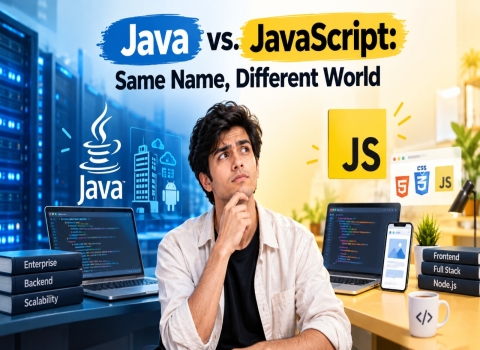
Java vs. JavaScript: Same Name, Different World — Which One Should You Learn?
Introduction: Clearing Up the Name Confusion
If you are new to programming, seeing "Java" in both Java and JavaScript might lead you to believe they are closely related or that JavaScript is simply an updated version of Java. However, they are completely separate technologies with vastly different architectures, execution models, and primary use cases. JavaScript is not an extension or next version of Java.
While Java was engineered as a structured, general-purpose programming language, JavaScript was created primarily to bring dynamic behavior and interactivity to web pages. To evaluate which language to learn, you must look past the similarity in their names and analyze them strictly by their practical applications and development goals.
Understanding Java: Enterprise Architecture and Scalability
Java is a mature, general-purpose programming language designed with an emphasis on structure, reliability, and object-oriented principles.
• Compilation and Portability: When you write Java code, the source code is compiled first and then executed by the Java Virtual Machine (JVM). This specialized runtime ecosystem gives Java its defining strength: platform portability.
• Object-Oriented Design: Java strongly enforces Object-Oriented Programming (OOP), encouraging developers to model real-world concepts into structured software entities.
• Enterprise-Grade Power: Java shines brightest when building large-scale applications with complex business logic, heavy user traffic, and demanding performance requirements. Its mature ecosystem offers reliable engineering practices and long-term maintainability.
• Android Development: Historically, Java has played a foundational role in building Android mobile applications and backend service infrastructure.
________________________________________
Understanding JavaScript: The Interactivity Engine of the Web
While Java focuses on backend structure and execution environments, JavaScript serves as the fundamental language powering the modern web.
• The Third Pillar of Web Design: Standard web development relies on three core layers—HTML provides page structure, CSS defines visual presentation, and JavaScript controls dynamic behavior. JavaScript brings static pages to life by driving button clicks, live updates, interactive menus, and rich client experiences.
• Direct Browser Execution: JavaScript's massive advantage in web development stems from its ability to run directly inside web browsers without requiring external installation.
• Full-Stack Capabilities with Node.js: JavaScript is no longer confined to frontend client browsers. Through server-side runtime environments like Node.js, JavaScript developers can manage backend databases and server operations, making it a versatile tool for full-stack engineering.
Co-existence: How Java and JavaScript Work Together
Rather than competing directly, Java and JavaScript frequently collaborate within the exact same software application.
Modern web architecture often adopts a layered division of labor:
• Frontend Layer: JavaScript manages client-side user interface interactions, visual state, and dynamic screen updates.
• Backend Layer: Java handles background business logic, secure database interactions, data processing, and enterprise system architecture.
Developers can choose to build an all-JavaScript stack across client and server, or pair a powerful Java backend with an interactive JavaScript frontend.
Which Language Should You Learn?
The decision between Java and JavaScript comes down to what you aim to build rather than which language is objectively "best".
• Choose JavaScript if: Your primary goal is web development, creating interactive browser applications, or becoming a full-stack web developer.
• Choose Java if: You want to focus on enterprise backend architectures, large-scale systems, complex business logic, or Android software engineering.
Key Takeaways and Mindset Advice for Developers
Regardless of which technology you select, adopting the right engineering mindset is essential for long-term growth:
1. Pick the Goal Before the Tech: Define the specific project or career path you want to pursue before picking a programming language.
2. Focus on Problem-Solving Over Syntax: Memorizing syntax rules is only the first step; true engineering skill comes from solving real-world problems.
3. Embrace Errors as Growth: Facing bugs and runtime errors is where real learning begins.
4. Build Real Projects:
o If you choose Java, don't just write basic script exercises—build functional backend systems.
o If you choose JavaScript, build real interactive web applications.
5. Focus on Tangible Output: Programming languages are simply tools; what matters most is your problem-solving mindset and ability to deliver meaningful, working results on screen.